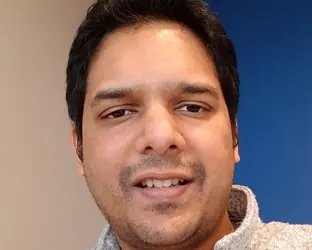
I was pulling systems apart to see how they broke long before anyone paid me to build them.
Professionally that is twenty-seven years now: networks, then servers, then databases, then architecture, then teams, and lately AI. The shape keeps changing and the underlying question never does, which is what happens when this breaks and who finds out first. I still write code most weeks, because a technology leader who has not touched the stack in three years is guessing, and the team can always tell.
I am from Colorado, in the United States, and went to school at Ananda College Colombo in Sri Lanka. Australia came next: the residential college network and the Lotus Domino website at Charles Darwin University in the Northern Territory, which were the first systems I was genuinely responsible for keeping alive. Then the US Army and Iraq, back to Colorado, and eventually New Jersey. The degree, a bachelor's in computing from Charles Sturt University, came after the military, finished while I was already working.
How I work
Architecture
I design the shape of a system before anyone writes code: data model, failure modes, where the load lands, what happens at 3am when a dependency goes away. Then I stay close enough to the implementation to find out whether the design survived contact with reality.
Leadership
Technical strategy, hiring, and delivery, including M&A integrations and cloud migrations. I have taken teams through the unglamorous part, where two companies' systems have to become one without anybody's customers noticing.
Security
I came up reverse engineering and debugging at the instruction level, fascinated by how things break. That lens never left. Security is part of the architecture, decided early, not a hardening pass bolted on the week before launch.
AI, where it pays
LLM applications, retrieval-augmented generation, agents, and the evaluation harnesses that catch regressions before users do. The interesting question is rarely whether a model can do something. It is whether the output is reliable enough to put in front of a customer.
Work with me
I take on architecture reviews, infrastructure and platform work, and fractional CTO engagements. If something in your stack is about to break at 3am and you would rather find out now, that is the conversation I am useful in.